Nanoplastics in aqueous environments: structure, migration, transport and remediation
N1-0308

ARIS project code: N1-0308 (B)
Project title: Nanoplastics in aqueous environments: structure, migration, transport and remediation
Slovenian project title: Nanoplastika v vodnem okolju: struktura, migracija, transport in sanacija
Slovenian principal investigator:
prof. dr.
Tomšič Matija
ARIS funding period: 1. 01. 2023 – 31. 12. 2025
NKFIH project code: SNN142258
Hungarian principal investigator: assoc. prof. dr. István Szilágyi
On the Hungarian side, the project was extended until 30 June 2026.
Members of the Slovenian project group:
Project summary
The joint NKFIH/ARIS project (SNN142258/N1-0308) addressed nanoplastics in aquatic environments as a new class of contaminants whose migration, transport, and remediation options are determined by particle colloidal stability. The work was carried out jointly by the Slovenian and Hungarian teams within three project tasks: T1 – migration of nanoplastics in the presence of salts and mineral particles; T2 – transport of per- and polyfluoroalkyl substances (PFAS) in relation to adsorption onto nanoplastics; and T3 – water remediation using adsorbents based on biocompatible clay materials, especially layered double hydroxides (LDH) and related systems.

Scheme. Left: Schematic representation of NPL transport (chemical structures of PET, PS, and PE) and of composites formed by adsorption of contaminants or by heteroaggregation with mineral particles. Right: Chemical structures of selected industrially relevant per- and polyfluoroalkyl substances (PFAS).
Within T1, we showed that electrolyte composition, ionic strength, ion valence, and mineral components strongly affect the aggregation and stability of plastic particles. In mixed NPL/LDH systems, we confirmed heteroaggregation, charge neutralization, charge reversal, and stable as well as unstable regimes at different particle mass ratios. Within T2, we showed that PFAS adsorption onto NPL depends on surface charge, fluorocarbon chain length, and functional group type; PFOS shows higher affinity for positively charged nanoplastic particles than PFOA. T3 focused on the removal of NPL and related contaminants from water by LDH-based materials, in situ synthesis of adsorbents, and design of composite materials.
The project resulted in four joint scientific papers by Slovenian and Hungarian researchers, conference presentations, and additional separate publications by both groups. Two further joint manuscripts are currently under review, and additional outputs are still expected on the Hungarian side because the Hungarian project was extended until 30 June 2026. Overall, the project contributed to the physicochemical understanding of migration, transport, and remediation of emerging aquatic contaminants and provided a basis for improved environmental risk assessment and water treatment.
The participating groups contributed complementary expertise and facilities throughout the project. The Slovenian team made key contributions in light scattering, SAXS/SWAXS, methodological development, theoretical approaches, and molecular-dynamics simulations, whereas the Hungarian team contributed strongly in materials synthesis, electron microscopy, and remediation experiments.
Objectives and realization
The project was organized into three interrelated tasks: T1 – migration of nanoplastics in aquatic environments, T2 – transport of PFAS in association with nanoplastics, and T3 – water remediation using biocompatible clay-based and related adsorptive materials. In T1, we quantitatively clarified the effects of salt type, ionic strength, ion valence, and mineral particles on aggregation, heteroaggregation, stability, and hence migration of nanoplastics. In T2, we clarified PFAS adsorption onto nanoplastics, charge regulation, aggregation, and co-transport of PFAS with nanoplastics. In T3, we experimentally substantiated an ex situ remediation approach based on LDH particles, verified the conceptual feasibility of an in situ approach, and established the physicochemical basis for further development of LDH-HNT composite systems.
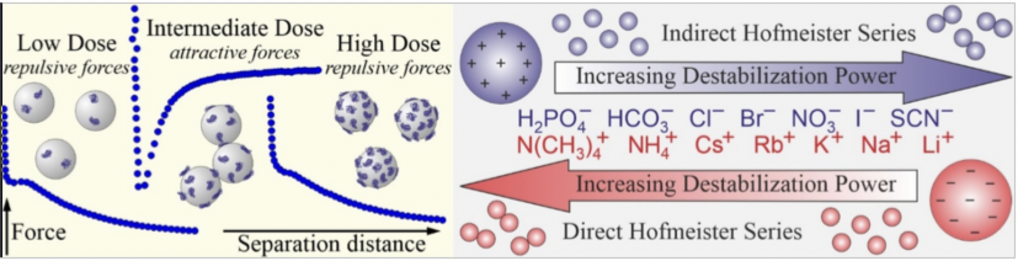
Scheme: Left: Adsorption of polyelectrolytes or oppositely charged particles onto plastic particles and the effect of dose on the nature of interparticle forces. Right: Direct and reverse Hofmeister series of anions and cations used to interpret destabilization of hydrophobic plastic particles with negative or positive surface charge.
An important methodological outcome of the project was the development of an improved angle-dependent X-ray absorption correction procedure for SAXS/SWAXS data. This result was essential for the study of strongly absorbing fluorinated systems (PFAS) and provides a solid basis for future work on PFAS solvation, PFAS association with nanoplastics, and reliable interpretation of scattering data supported by molecular-dynamics simulations.
Project phases and their realization
- T1 – NPL migration: fully achieved; we explained how salts, mineral particles, and heteroaggregation affect nanoplastic stability and migration.
- T2 – PFAS transport: achieved to a very high extent; we explained PFAS adsorption, charge regulation, and co-transport with nanoplastics, while part of the planned SAXS/SWAXS structural work developed into a dedicated methodological manuscript.
- T3 – water remediation: achieved to a very high extent; the ex situ LDH approach was experimentally substantiated, the in situ approach was verified at a conceptual level, and the physicochemical and structural basis for LDH-HNT composites was established for future optimization.
Results and bibliography
The direct outputs of the project comprise five key joint publications, additional related publications by the Slovenian and Hungarian groups, and one joint manuscript under review.
Key joint project outputs:
- D. Takács, T. Szabó, A. Jamnik, M. Tomšič, I. Szilágyi. Colloidal Interactions of Microplastic Particles with Anionic Clays in Electrolyte Solutions. Langmuir, 2023, 39(36), 12835-12844. DOI: https://doi.org/10.1021/acs.langmuir.3c01700 [COBISS.SI-ID 162892803]
- K. Bere, B. Bakk, E. Illés, M. Kocsis, A. Jamnik, M. Tomšič, I. Szilágyi. Role of Fluorocarbon Chain Length in the Adsorption of Perfluoroalkyl Substances on Nanoplastic Particles. ACS ES&T Water, 2024, 4, 5114-5121. DOI: https://doi.org/10.1021/acsestwater.4c00689 [COBISS.SI-ID 223993347]
- T. Péter, D. Takács, S. Sáringer, A. Szerlauth, K. Sajdik, G. Galbács, M. Tomšič, S. Shaw, K. Morris, G. Douglas, I. Szilágyi. Interaction between Uranyl Cations and Layered Double Hydroxide Nanoparticles: Implications for Nuclear Wastewater Management. ACS ES&T Water, 2024, 4(7), 3059–3067. DOI: https://doi.org/10.1021/acsestwater.4c00313 [COBISS.SI-ID 204971011]
- Z. V. Árok, S. Sáringer, D. Takács, C. Bretz, Á. Juhász, S. Puskás, I. Szilágyi, M. Tomšič, A. Jamnik. Structure of the Scleroglucan Biopolymer in Aqueous Solutions of Inorganic Salts and Ionic Liquids. ACS Omega, 2025. DOI: https://doi.org/10.1021/acsomega.5c02212 [COBISS.SI-ID 272762627]
- P. Tamás, D. Takács, B. Katana, Ş. M. Simav, G. Terjéki, V. Hornok, S. Sáringer, M. Tomšič, I. Szilágyi. PFAS-Induced Charge Regulation and Aggregation in Polystyrene Nanoplastic Colloids. The Journal of Physical Chemistry Letters. DOI: https://doi.org/10.1021/acs.jpclett.6c00866 [COBISS.SI-ID 277371395]
Additional publications of the Slovenian group:
- M. Gudelj, M. Kranjac, L. Jurko, M. Tomšič, J. Cerar, A. Prkić, P. Bošković. Structure and Potential Application of Surfactant-Free Microemulsion Consisting of Heptanol, Ethanol and Water. Colloids and Interfaces, 2024, 8(5), 53. DOI: https://doi.org/10.3390/colloids8050053 [COBISS.SI-ID 209555203]
- M. Gudelj, M. Kranjac, I. Hajdin, M. Tomšič, J. Cerar, A. Prkić, P. Bošković. Design of Surfactant-Free Microemulsions Composed of n-Pentanol, Ethanol, and Water: Application in Silica Nanoparticle Synthesis. Inorganics, 2025, 13(12), 392. DOI: https://doi.org/10.3390/inorganics13120392 [COBISS.SI-ID 259767811]
- I. Milošev, T. Pavlovčič, M. Tomšič. Molybdate and Vanadate Ions as Corrosion Inhibitors for Clad Aluminium Alloy 2024-T3. Electrochimica Acta, 2024, 504, 144893. DOI: https://doi.org/10.1016/j.electacta.2024.144893 [COBISS.SI-ID 205238275]
- I. Elrefaey, H. Mahgoub, C. Vettorazzo, M. Marinšek, A. Meden, A. Jamnik, M. Tomšič, M. Strlič. Investigation of the Structural Changes in Silk due to Tin Weighting. Polymers, 2024, 16, 2481. DOI: https://doi.org/10.3390/polym16172481 [COBISS.SI-ID 206222851]
- L. Brenjo, A. Oklješa, M. Tomšič, B. Barta Holló, J. Nešić, E. Tóth, Č. Podlipnik. Polymethylenetetrazole: Synthesis, Characterization, and Energetic Properties. Molecules, 2024, 29, 3389. DOI: https://doi.org/10.3390/molecules29143389 [COBISS.SI-ID 270394371]
- R. Masimov, M. Tomšič, E. K. Wasan, et al. External Electric Field Modulation of Polyelectrolyte Complex Nanoparticles for Vaccine Delivery. Journal of Drug Delivery Science and Technology, 2026, 117, 108031. DOI: https://doi.org/10.1016/j.jddst.2026.108031 [COBISS.SI-ID 266243843]
Additional publications of the Hungarian group:
- N. B. Alsharif, T. G. Halmágyi, M. A. Hempenius, G. J. Vancso, C. Nardin, I. Szilágyi. Nanoscale, 2023, 15, 11875–11883.
- K. Bere, X. Xiong, S. Sáringer, G. Douglas, I. Szilágyi. Journal of Molecular Liquids, 2023, 384, 122285.
- B. Katana, J. Baptista, R. Schneider, R. J. de Oliveira, I. Szilágyi. Journal of Physical Chemistry B, 2024, 128, 6957–6965.
- S. Sáringer, G. Terjéki, Á. Varga, J. Maléth, I. Szilágyi. Langmuir, 2024, 40, 16338–16348.
- Z. V. Árok, S. Sáringer, G. Papp, Á. Juhász, S. Puskás, I. Szilágyi. Energy & Fuels, 2024, 38, 6798–6805.
Manuscripts currently under review:
- J. Kovač, A. Jamnik, I. Szilágyi, M. Tomšič. Angle-Dependent X-Ray Absorption Correction in SWAXS: Accounting for Constrained Scattering Volume, Beam Profiles and Capillary Wall Attenuation. Manuscript submitted to Journal of Applied Crystallography.
Conference contributions:
- K. Kokalj, M. Tomšič, A. Jamnik. Simulacije molekulske dinamike fluoriranega etanola [poster], 13. konferenca fizikov v osnovnih raziskavah, Brdo pri Kranju, 18. november 2024. [COBISS.SI-ID 223801091]
- J. Kovač, A. Jamnik, I. Szilágyi, M. Tomšič. A SAXS and MD study of fluorinated alcohols inspired by environmental concerns regarding PFAS [poster]. In: MICROPLASTICdays: shaping the future of microplastic research, Faculty of Chemistry and Chemical Technology, Ljubljana, Slovenia, 25–27 March 2025: book of abstracts, str. 39. ISBN 978-961-7078-54-1. https://planterastics.fkkt.uni-lj.si/wp-content/uploads/2025/04/BOOK-OF-ABSTRACTS.pdf. [COBISS.SI-ID 234793219]
- J. Kovač, M. Tomšič, A. Jamnik. Structural investigation of different liquid fluorinated butanols using molecular dynamics simulations and X-ray scattering [lecture]. In: Postgraduate Chemical Sciences 2025: PRECISE2025 International Conference, book of abstracts, June 5–6, 2025, str. 38. https://fkkt.uni-lj.si/fileadmin/user_upload/za_studente/PRECISE2025_Conference_Abstract_Booklet.pdf. [COBISS.SI-ID 241032963]
- J. Kovač, K. Kokalj, A. Jamnik, I. Szilágyi, M. Tomšič. From hydrogen to fluorine: structural and dynamic consequences in alcohols explored by MD and SWAXS [lecture]. In: Chemistry, Physics and Biology of Colloids and Interfaces, Eger, Hungary, 15–19 June 2025: book of abstracts, str. 33. https://bit.ly/3SNWp99. [COBISS.SI-ID 241796355]
- J. Kovač, K. Kokalj, A. Jamnik, I. Szilágyi, M. Tomšič. Fluorinated alcohols as PFAS models: structural insights from SWAXS and molecular simulations [poster]. In: 39th ECIS and UK Colloids 2025, Bristol, UK, 7–12 September 2025: poster booklet, str. 117. [COBISS.SI-ID 266138883]
- J. Kovač, A. Jamnik, I. Szilágyi, M. Tomšič. Understanding fluorination effects on butanol derivatives using molecular simulations and X-ray scattering. In: At the Crossroads of Three Realms: Cutting Edge Conference 2025, Faculty of Chemistry and Chemical Technology, Ljubljana, 15 September 2025: book of abstracts, str. 25. ISBN 978-961-7078-60-2. http://www.cutting-edge.si/wp-content/uploads/2025/09/CE-BoA-2025.pdf. [COBISS.SI-ID 249204995]
- J. Kovač, K. Kokalj, A. Jamnik, I. Szilágyi, M. Tomšič. Structural and dynamic effects of fluorination of alcohols: insights from MD simulations and SWAXS [oral presentation]. In: Slovenski kemijski dnevi 2025 = 31st Annual Meeting of the Slovenian Chemical Society, Portorož, Slovenia, 17–19 September 2025: book of abstracts, str. 88. ISBN 978-961-95922-5-0. https://skd2025.chem-soc.si/wp-content/uploads/2025/08/1SKD-2025-Book-of-Abstracts-260825-compressed.pdf. [COBISS.SI-ID 253042435]