Chemistry of catalysts for clean air
P1-0418
Duration: 1.1.2022 - 31.12.2027
Head: prof. dr. Nataša Novak Tušar
Head at FKKT:
znanst. sod. dr.
Papan Djaniš Jelena
The main promoter of the programme “Chemistry of catalysts for clean air” is the Institute of Chemistry in Ljubljana. At the same time, researchers from the Department of Inorganic Chemistry are co-investigators of the programme. Part of the programme in which our researchers are involved is the synthesis of new catalysts/photocatalysts for air purification with targeted structural properties in parallel with the development of new characterisation approaches.
In today's world, clean air is one of humanity's top priorities for human health and climate change. Air pollution refers to the emission of pollutants into the air from industrial processes, means of transport and consumer products. Both the control of pollution sources and air purification are important for improving air quality. Control of pollution sources means using thermal and catalytic processes in industrial processes and transport.
Air purification is possible by using catalysts which, as metal active sites, can act on supports or independently in different sizes (single atoms - 0.1 nm, nanoclusters - 1 nm, nanoparticles - 5 nm) and behave differently for different heterogeneous catalytic reactions. Among the many factors influencing catalyst behaviour are particle size and shape, chemical composition, metal-support interaction and metal-reactant/solvent interaction, but the most important are:
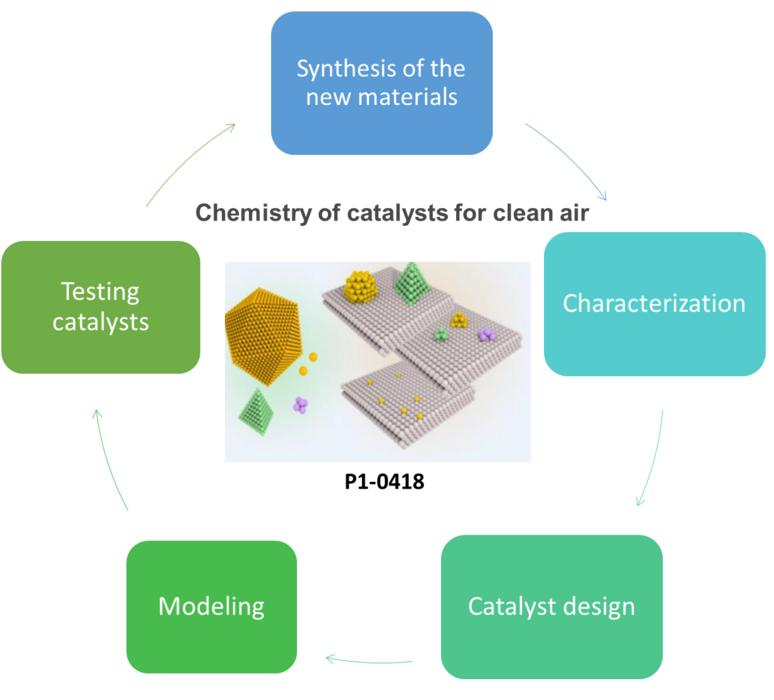
(a) the intrinsic electronic difference and binding abilities during the transition from single atoms to clusters and nanoparticles; and (b) the dynamics of the catalytic process characteristics, which are driven by the metal-reactant and/or the metal-solvent interactions. Light-reactive catalysts are photocatalysts. A review of the literature on photocatalysis reveals that over the last 10 years more than 1300 international patents per year have been filed for various applications of photocatalysts, mainly in the fields of pollution remediation, green synthesis and solar energy conversion. Pollution remediation, including water and air purification, is one of the most important areas in the world today.
In the field of catalysts that clean industrial waste air before it is released into the environment, we will synthesise innovative catalysts that can operate at low temperatures. Volatile organic compounds (VOCs), which are emitted into the air mainly from industrial processes, transport and consumer products, are a major group of air pollutants and are toxic and carcinogenic. In our programme, we will design and develop transition metal oxide catalysts on alumina as a support that operates at lower temperatures.
In the field of photocatalysts that clean polluted indoor and outdoor air, we will synthesise innovative photocatalysts that exploit a high proportion of the solar spectrum. Over the last decade, science has intensively studied different Advanced Oxidation Process (AOP) systems, as they can completely decompose organic pollutants such as VOCs into inorganic compounds such as H2O, CO2 and inorganic salts. The most well-known photocatalyst using AOPs is TiO2. Our mission is to make new, improved Tio2-based materials that work in the visible part of sunlight. The new materials will be prepared by doping TiO2 with metals and/or non-metals.
In the field of photocatalysts, which convert N2 and CO2 from air into valuable chemicals, we will synthesise innovative photocatalysts for the photocatalytic conversion of N2 and the photo-thermo-catalytic conversion of CO2.